Kids Cipher Puzzles Printable | YHO Build It For Me
By The YHO Team · October 22, 2026 · 4 min read
What a shift key does, why a cipher page works as reading practice, and how to start one without a lecture.
Table of contents
- What the shift key means
- Why it works as reading practice
- Starting a page
- Keeping it short
- What to write your own cipher with
- Common stumbles
- Where this goes next
- Making the key once and keeping it
- Three short codes to write tonight
- What a child learns from a wrong decode
- A code for something real
- Where to start
A kids cipher puzzles printable page gives a child a coded word and a key, and asks them to turn the code back into letters. That is the entire mechanic. It is also, quietly, one of the most useful reading exercises on paper, because it makes a child look at individual letters and their order.
What the shift key means
A shift cipher moves every letter a fixed number of places along the alphabet. Shift 2 means A becomes C, B becomes D, and Z wraps around to B.
The key on the page is a two-row table: the real alphabet in the upper row, the shifted alphabet underneath. A child does not need to hold the shift in their head. They need to find a letter in the upper row and read the letter below it.
That table is the whole tool. Explain it once, then point at it.
Why it works as reading practice
Decoding forces attention to letters as objects. A child who can read a word by shape can also skim past it. A cipher makes skimming impossible: each letter has to be found and translated.
That is useful for children who guess at words. It is also useful for children who are just learning letter sounds, because the alphabet table reinforces order and shape.
Starting a page
- Read the key together. Point at three letters and say what each becomes.
- Decode the first letter of the first word together.
- Let the child do the next two.
- If they are moving, step back and let them finish.
Do not solve the whole word for them. The moment of 'oh, it says cat' belongs to the child.
Keeping it short
A cipher page is slow work. One word is a session at four, three words is a session at six. Print one page and use half of it.
If the child is tired, stop mid-word and put the page in a folder. A code is easy to return to because the key is printed above the code.
What to write your own cipher with
Short, familiar words: cat, sun, map, bed. Three letters is right for a first page. Avoid words with double letters at first, because the shift makes them look strange and children second-guess themselves.
For a second page, use the same key with different words. Changing the key too often turns the activity into a new lesson each time.

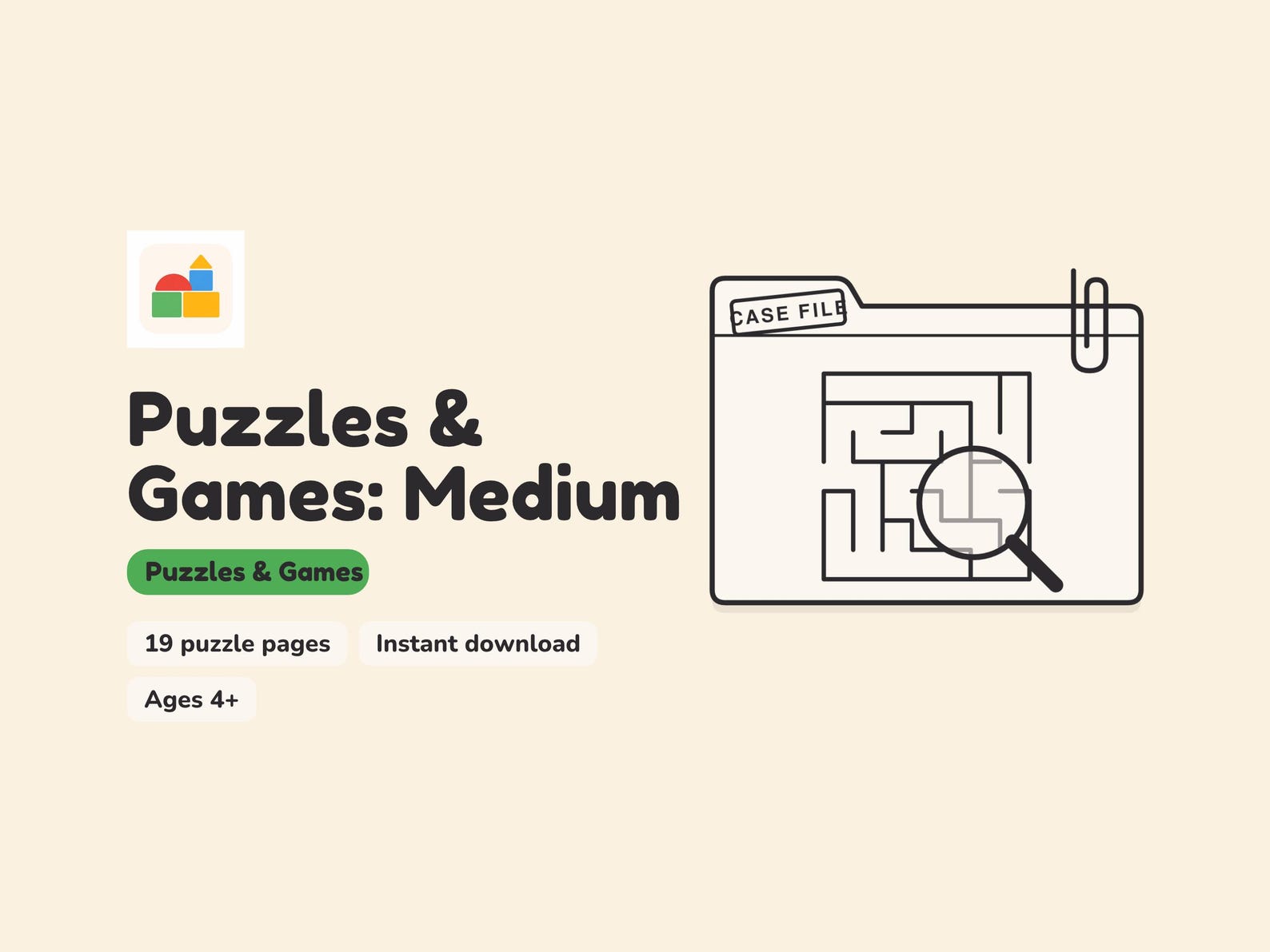
Puzzles & Games: Hard
19 expert pages: ciphers, logic grids, sudoku-style puzzles and crosswords.
View printableCommon stumbles
The most common is losing the place. A finger under the code letter fixes it. The second is reading the lower row as the answer and the upper row as the code; mark the upper row lightly with a pencil so the direction is obvious.
Where this goes next
For the teaching sequence, this guide to a shift cipher for kids walks through it one letter at a time. For other deduction work, read the step-by-step logic grid method.
Making the key once and keeping it
A shift cipher page works because the key sits beside the code. If the key is on a separate sheet, it gets lost, and the page stops being independent.
Draw the two-row table on a strip of card stock and keep it in the folder with the pages. One key serves every page that uses the same shift, which is why it is worth making the shift a number a child can remember: shift two, shift three. Write the number in the corner of each coded page so the key can be matched to it.
Three short codes to write tonight
A first code should be three letters, lower case or capitals, with a familiar word: sun, cat, map. Encode it with a shift of two and write the key above it.
A second code can be a short message of two words, with spaces left unencoded. A third can be the child's own name, encoded, which they will decode quickly and enjoy enormously.
Hand-drawn codes work as well as printed ones. Kids cipher puzzles printable sets save the drawing time, not the thinking.
What a child learns from a wrong decode
A word that comes out as nonsense is not a failure. It is evidence that one letter was misread, and the child can go back and find it. That correction is more valuable than getting it right first time.
A code for something real
A cipher is more interesting when the message matters. Encode where the biscuits are, what the next outing is, or the name of a visitor. A kids cipher puzzles printable page with a real message behind it gets finished faster than a page of random words, and the child will ask for another. Keep the shift small and consistent for a few weeks, then change it once and let them notice. Noticing that the key changed is a genuine moment of understanding, and it is worth more than a page of decoded nonsense words.
Where to start
Write a three-letter word in shift 2 on a piece of paper and decode it together. Hard puzzle books with ciphers, loops and logic grids are in the YHO Build It For Me shop.
Frequently asked questions
What is a shift key in a cipher?
A fixed number of places a letter moves along the alphabet. Shift 3 turns A into D, B into E, and so on, wrapping around at the end.
How do I introduce kids cipher puzzles printable pages?
Start with one word and the key written above the code. Decode the first letter together, then let the child finish the word.
Do cipher puzzles help with reading?
They give a child a reason to look closely at letters and their order. That close attention is the same habit reading needs.
Some links go to the Etsy shop. Every printable here is one I would use in my own learning routine.