Montessori Activity Ideas | YHO Build It For Me
By The YHO Team · September 5, 2026 · 4 min read
Everyday Montessori-inspired activities with household objects, before a single page is printed.
Table of contents
A Montessori activity at home does not begin with a purchase. It begins with watching what your child already tries to do: pour the water, carry the bowl, wipe the table, put the shoes in a line. The work is already there. The adult's job is to make it possible.
That is a relief if you have priced wooden materials lately. A child does not need a full set of anything to get the benefit of a prepared environment. They need a few objects at their height, a clear place to work, and an adult who does not take over.
Start with practical life
Practical life is the part of the approach that lives in the kitchen. A small jug of water and a glass. A cloth for wiping. A bowl of dry beans and two cups. These activities have an obvious purpose, which is why children return to them without being asked.
Set up one tray at a time. Put it where the child can reach it without help. Show the whole cycle once, slowly, including the wiping up. Then step back and let them run it badly for a while. Accuracy arrives through repetition, not correction.
Then sensorial work
A Montessori activity built around the senses usually asks a child to compare: rough and smooth, big and small, loud and quiet. You can do this with a basket of household items in two minutes.
- A pair of socks, one thick and one thin.
- Three spoons of different lengths.
- A bowl of buttons sorted by size.
- Two scarves, one silky and one scratchy.
Name the difference out loud once and let the child handle the objects. The vocabulary sticks because it is attached to something in their hand.
Keep the room working
A prepared environment is mostly subtraction. Clear the clutter off one low surface. Put three activities on it. Leave the rest in a cupboard and rotate every two weeks. A child who can see everything at once usually chooses nothing.
Small tables help more than shelves. A child working on the floor with a tray has the same experience as one at a wooden table, and it costs nothing.
The adult's part
Observe, prepare, and get out of the way. Say less than feels natural. Resist demonstrating a second time while the child is mid-task. When they look up, that is your cue to be available, not to instruct.
If you are used to narrating and praising, this will feel strange for a week. Many parents find that a quiet adult produces a longer attention span almost immediately, though not on the first afternoon.
Where printables fit
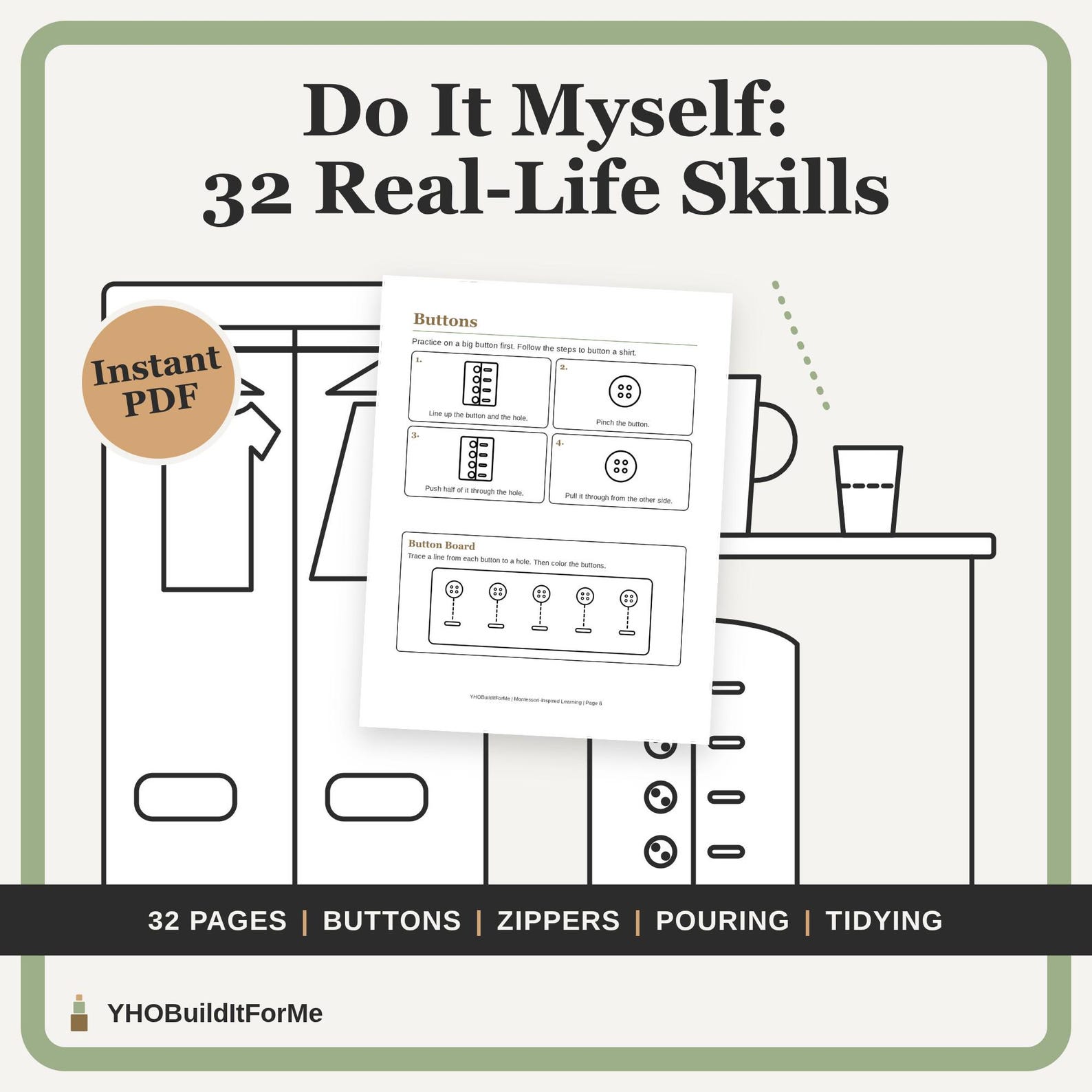
Montessori Practical Life Printable
32 printable pages of real-life skills: buttons, zippers, pouring, tidying and table setting, with step-by-step pictures.
View printablePaper comes after hands, not before. Once a child has poured, sorted, and folded real objects, a printed page can extend the same idea: a sorting mat, a sequence card, a tracing line. It is a support, not the main event.
For more on the same approach, read Montessori inspired learning at home and the homeschool preschool daily routine.
Setting up a tray that works
The difference between a Montessori activity that runs and one that needs you is usually the tray. Four rules cover most of it.
One activity per tray. One jug, one cup, one cloth. If two children can argue about which piece belongs where, there are too many pieces.
Everything included. If the job needs water, the tray needs the jug, the cup, and the cloth. A missing item means the child has to find you, which ends the independence.
Nothing precious. Use a plastic jug for a while. A child who is worried about breaking something works carefully for the wrong reason, and stops entirely after the first spill.
The tray fits the hands. Small hands, small jug. A litre jug is a two-handed lift, which is a different, harder task.
When a child refuses the work
Sometimes the tray sits there for a week. This is normal and rarely about the activity.
Check three things. Is it too hard, so the first step is unclear? Is it too easy, so there is nothing to do? Is it in a place where the child has to ask to reach it?
If all three are fine, leave it. Children return to materials that are simply available. Announcing the activity, demonstrating it a second time, or suggesting it repeatedly tends to have the opposite effect.
If it is still untouched after two weeks, take one piece away. A simpler version of the same Montessori activity often gets picked up the same afternoon.
Where to start
Choose one practical life job this week and set it up so your child can do it alone. When that routine holds, add one more. You can find printed supports, from sorting mats to sequence cards, in the YHO Build It For Me shop.
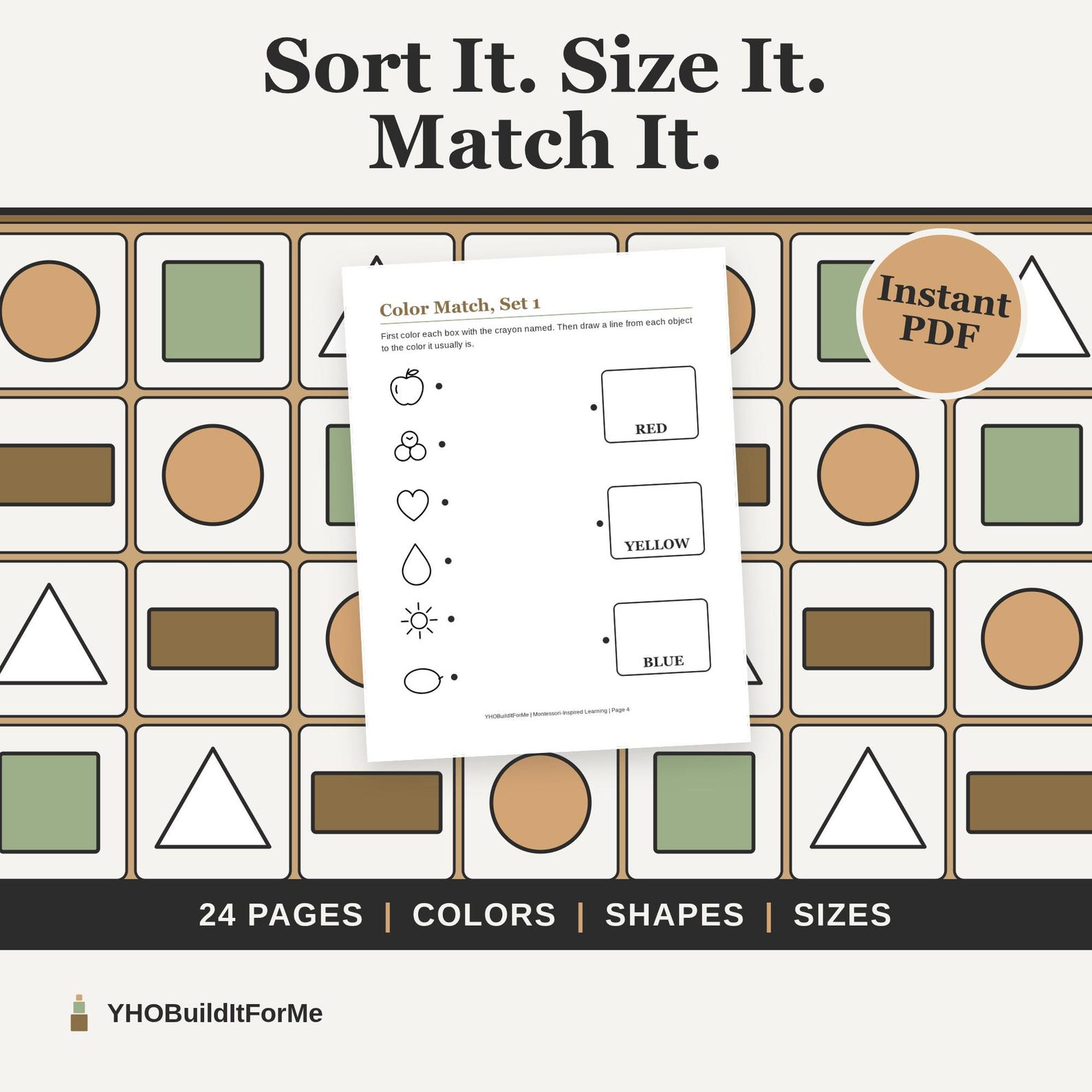
Sensorial Sorting Activities
24 printable sorting pages for colour, shape, size, length, weight and texture, one quality at a time.
View printableFrequently asked questions
Do I need Montessori materials to do a Montessori activity at home?
No. Most of the work uses what you already own: jugs, cloths, spoons, bowls, socks, and a tray. Materials help later, not first.
What is the simplest Montessori activity to start with?
Pouring dry beans between two jugs on a tray. It needs one object, one clear goal, and a cloth for the spill.
How long should an activity last?
As long as the child stays with it. Ten focused minutes is a full session at four. Stop when interest stops, not when the tray is finished.
Some links go to the Etsy shop. Every printable here is one I would use in my own learning routine.