Montessori Inspired: What It Means | YHO Build It For Me
By The YHO Team · September 29, 2026 · 4 min read
What the phrase Montessori inspired actually claims, what it does not, and how to spot a page that means it.
Table of contents
The phrase Montessori inspired appears on a great many products, including mine. It is worth knowing exactly what it claims, because it is not a certification and it does not mean a product was approved by anyone.
Montessori inspired means the materials borrow the ideas: independence, real objects, one skill at a time, a child who can check their own work. It does not mean official, certified, or connected to a training body. If a page claims more than that, read the claim carefully.
The ideas a printable can actually carry
Paper is limited. It cannot replace a wooden material that a child handles and corrects by feel. What it can do is follow the same principles in a smaller way.
- One skill per page, so attention has somewhere to land.
- A clear first step and a clear ending, so the child knows when the work is done.
- Control of error, so the answer can be checked without an adult. A self-correcting puzzle does this; a page with the answers hidden does not.
- Real, uncluttered images rather than cartoon characters with faces on everything.
- No rewards, stickers, or points. The work is the reward, or the page is not doing its job.
Those five are the test. A page that passes all five is reasonably described that way, whatever the shop says.
What it does not mean
It does not mean the page is part of a curriculum. It does not mean a child will learn to read by Friday. It does not mean the printable has been reviewed by a school, a trainer, or anyone else. And it does not mean you need to buy a set of wooden materials to use it.
It also does not mean a household with no screens at all. Paper and screens can coexist; the point is what the child is doing, not what the material is made of.
How the ideas show up in practice
A Montessori inspired sorting page gives a child two mats and a pile of pictures, and the pictures are self-checking because each belongs to exactly one group. A tracing page has one line weight and no decoration competing for attention. A practical life card shows four steps and lives on the shelf next to the actual jug and cloth.
None of that is complicated. It is mostly restraint, which is harder to design than it sounds.
Using the phrase honestly
If you make or sell materials, use the phrase and then show the reasoning: one skill, control of error, real objects. If you buy them, use that reasoning to judge, and ignore the badge-shaped graphics that imply an endorsement.
For more on putting the ideas to work at home, read Montessori activity ideas with household objects and the starter guide to learning at home.
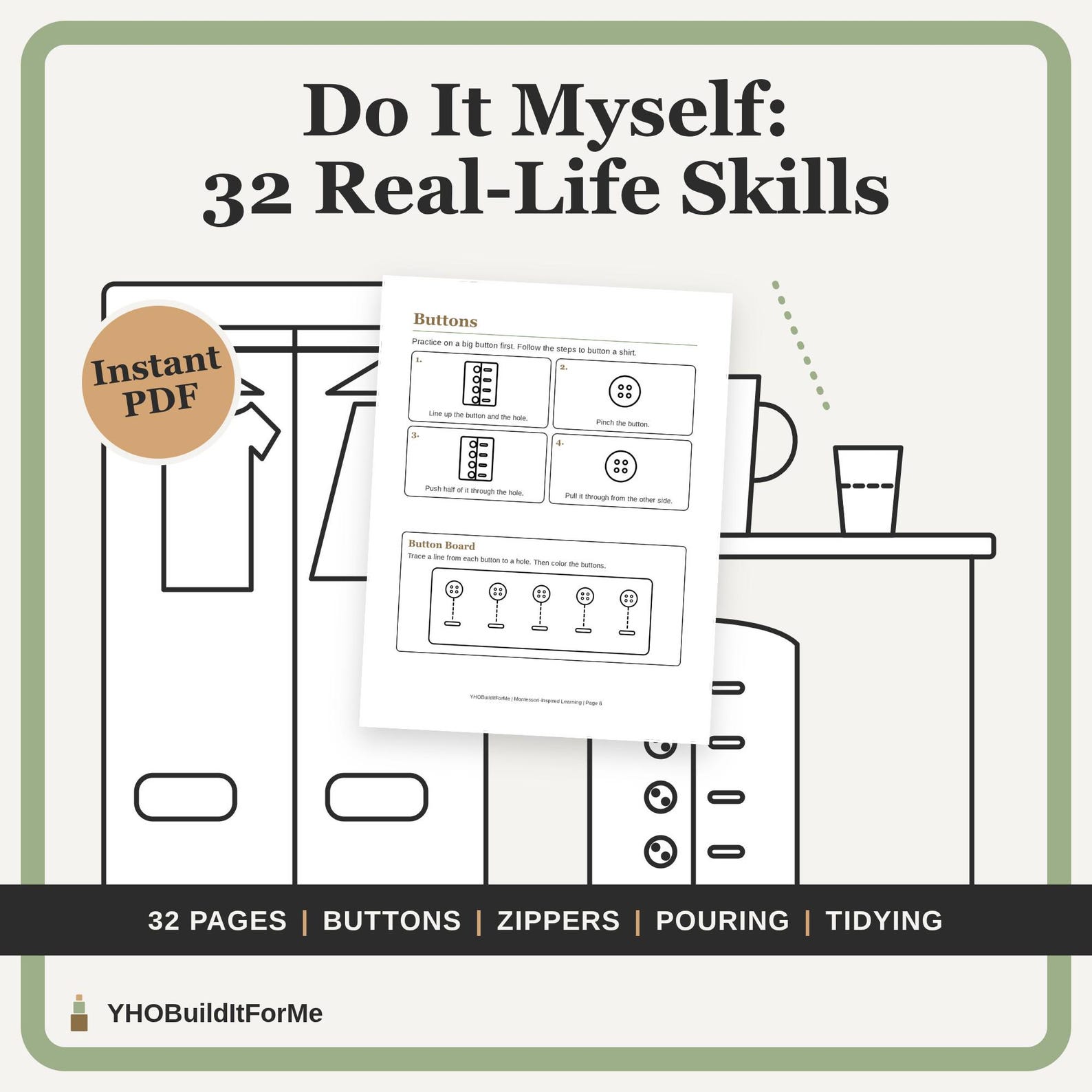
Montessori Practical Life Printable
32 printable pages of real-life skills: buttons, zippers, pouring, tidying and table setting, with step-by-step pictures.
View printableWhere the phrase gets used badly
The phrase is easy to borrow. A page with a wooden texture behind a cartoon animal is not Montessori inspired, whatever the listing says. A bundle of forty pages with a star chart at the bottom is closer to a reward system than to the ideas.
Three uses worth questioning:
A page that fills every inch, leaving no white space for the hand to work. Clutter is the opposite of a prepared environment.
A page where the adult holds the answer key. If a child cannot check their own work, the page needs a supervisor.
A page with a points total. Points make the score the point, and the score is never the point.
A quick test in a shop
Look at one page and answer four questions in ten seconds.
Is there one instruction? Can a child see when it is done? Can the child tell whether they got it right? Is the picture calm enough to look at without a headache?
Four yes answers is a reasonable page. Three is still usable. Two means you are buying the theme rather than the work, which is allowed, as long as you know that is what you are doing.
A phrase worth keeping honest
The words Montessori inspired are useful when they describe a method and misleading when they imply approval. A page can be genuinely built on the ideas and still be a piece of paper, and that is fine. What matters is whether the paper gives a child something to do alone, something to check, and a clear place to stop. Test every material, printed or wooden, against those three. If it passes, the phrase is doing its job. If it needs an adult standing over it, the phrase is decoration, and the page will sit in a drawer regardless of what the listing says about it.
The phrase is a description of a method, not a badge. Judge the page, not the label.
Where to start
Choose one page this week and test it against the five ideas above. Pages built with one skill and a clear ending are in the YHO Build It For Me shop.
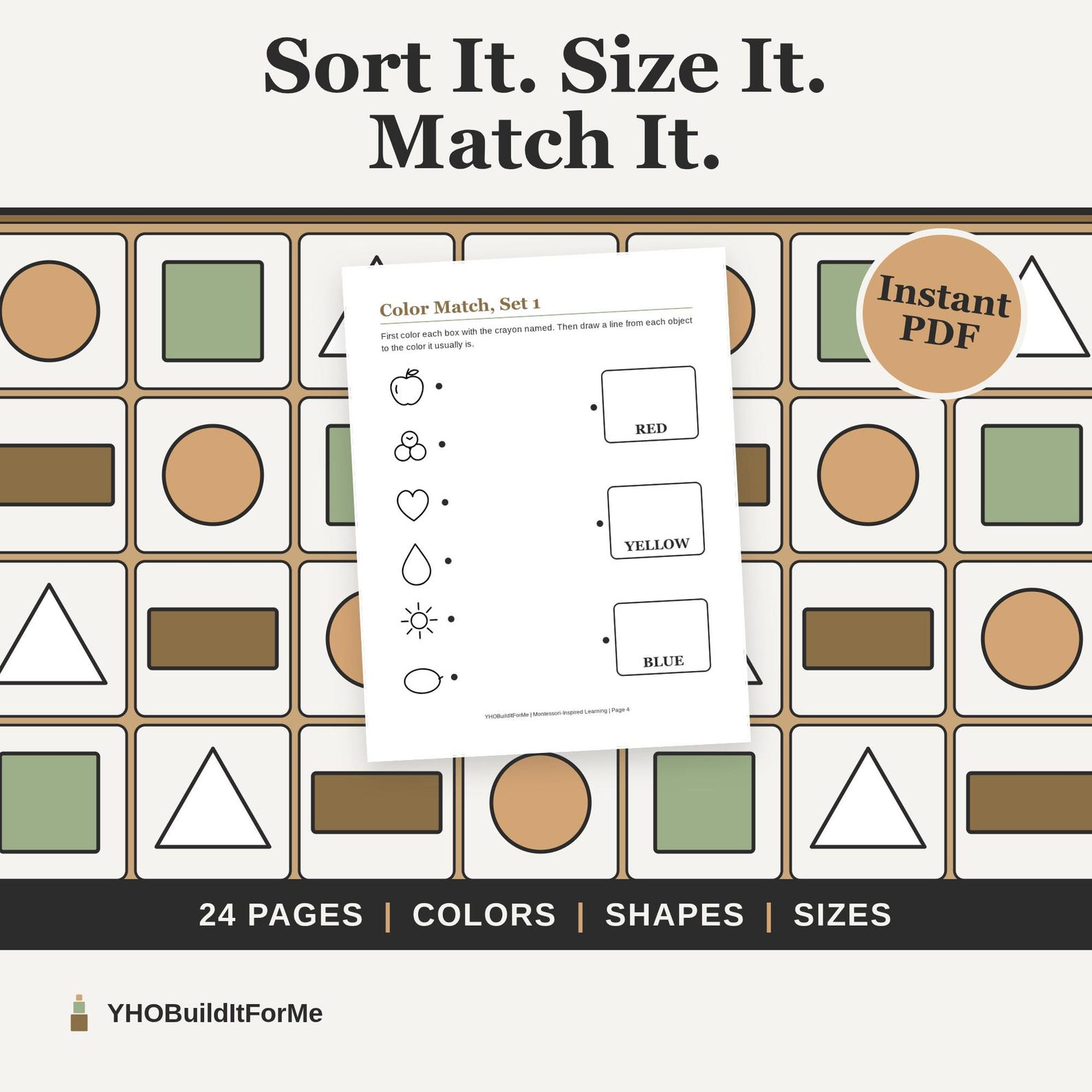
Sensorial Sorting Activities
24 printable sorting pages for colour, shape, size, length, weight and texture, one quality at a time.
View printableFrequently asked questions
Does Montessori inspired mean the same as Montessori?
No. Montessori inspired describes materials built on the ideas, such as independence and real objects. It is not a certification or an affiliation.
How can I tell if a printable is really Montessori inspired?
Look for one skill per page, real photographs or clear drawings, control of error so a child can check their own work, and no reward charts.
Is a Montessori inspired printable suitable for a child not in a Montessori school?
Yes. The ideas about independence and short practice sessions work in any home, whatever school the child attends.
Some links go to the Etsy shop. Every printable here is one I would use in my own learning routine.