Printable Puzzle Books for Kids | YHO Build It For Me
By The YHO Team · October 8, 2026 · 4 min read
How to choose a level, what belongs in a printed puzzle book, and how the three levels differ.
Table of contents
Printable puzzle books for kids are small collections of puzzles, printed at home and used a page at a time. Choosing one is mostly a question of level, because a printable puzzle book for kids that is too hard becomes a stack of folded paper within a week. The format matters more than it sounds: a book with one puzzle per page and a clear instruction line gets finished, while a dense grid of twenty puzzles gets abandoned.
This is the hub for choosing a level. The three levels below are the ones I use, and most families will work through all three within a year or two.
What belongs in a printed puzzle book
Four things, every time:
- One puzzle per page, with white space around it.
- A single instruction line above the puzzle.
- A level marker, so a child knows what they are taking on.
- An answer key at the back, so the work can be checked without an adult.
That last one is not a shortcut for the child. Checking your own work is a skill, and a book that makes it possible is doing something a stack of loose sheets cannot.
Easy: finish the job
Easy pages have wide paths, short routes, and matching or simple word searches. The goal is completion. A child who finishes three easy puzzles in a row learns that puzzles end and that starting the next one is worth it.
This level suits a child who is new to puzzles, usually around ages 4 and up, though comfort matters more than age.
Medium: hold a plan
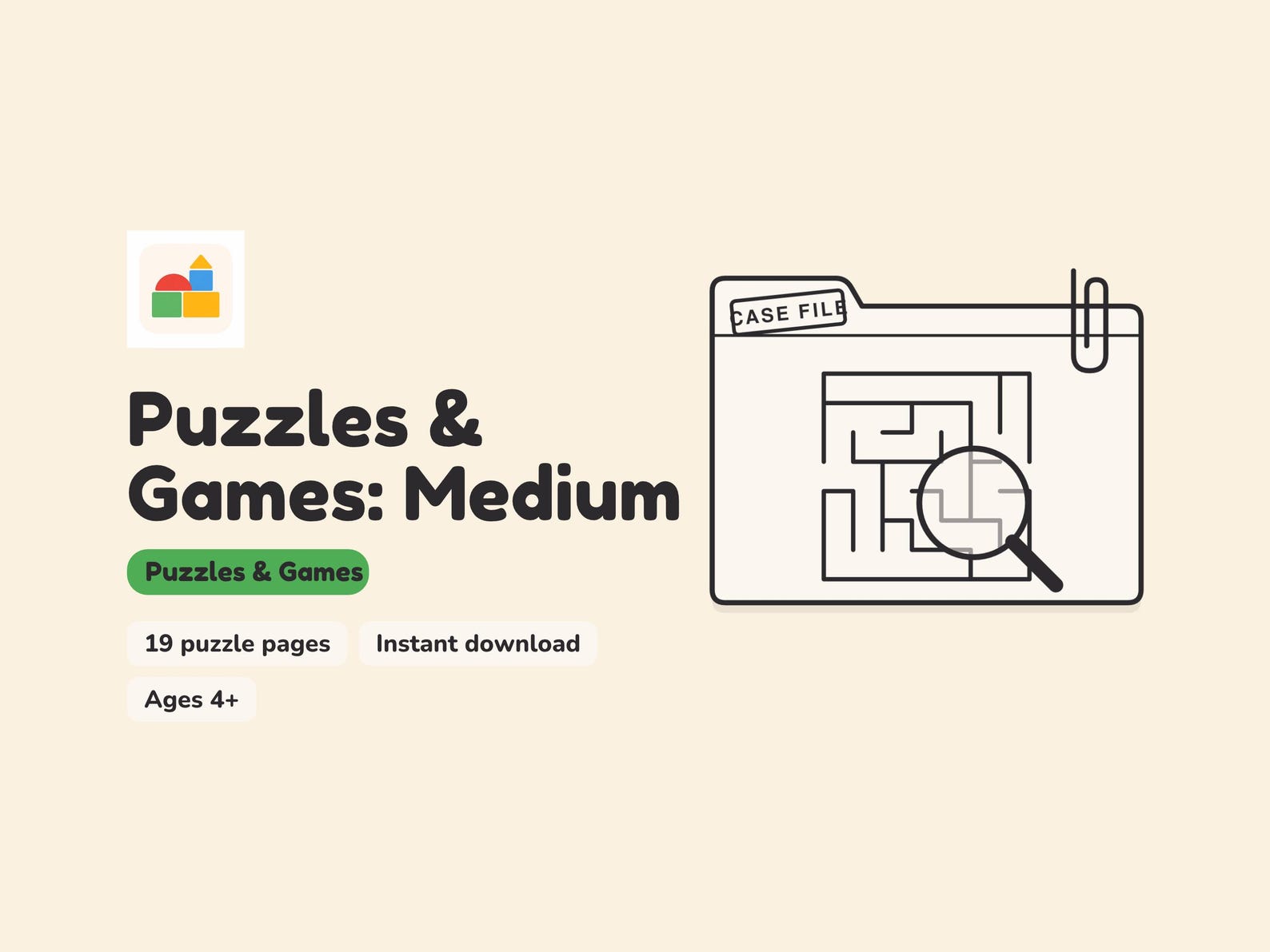
Medium pages add dead ends, longer routes, and simple logic grids. The child has to look ahead and back out of a wrong turn. This is where pencil control and patience grow together, and where a little conversation is normal.
Expect the first few medium pages to need company. Expect the tenth to be independent.
Hard: work past the first idea
Hard pages add loops, ciphers, and logic grids with more categories. These suit a child who already finishes medium work comfortably and wants more. In our house the hard book was the one saved for ages 8 and up, simply because that was when the attention span arrived.
Watch for frustration rather than effort. Effort looks like a furrowed brow and a moving pencil. Frustration looks like the pencil being put down hard.
How to use the answer key
Let the child check a finished page, then decide whether to try it again. Do not check mid-page, and do not use the key as a correction tool. The point of a self-checking book is independence.

Puzzles & Games: Hard
19 expert pages: ciphers, logic grids, sudoku-style puzzles and crosswords.
View printableWhere to go next
If you are planning a week of puzzle time rather than choosing a book, this puzzle week plan covers pacing. For maze levels specifically, read printable mazes for kids.
How a book differs from loose pages
A book has an order, and the order does work. Easy pages at the front let a child warm up without being told to. Hard pages at the back give a visible ladder. An answer key at the end makes checking independent.
Loose sheets lose all of that. They are cheaper and easier to print, and they are also the reason a household ends up with a drawer of half-finished mazes.
If you print your own, staple a set of ten and write the level on the front. That small binding is enough to turn paper into a book.
What a level marker does
A printed level marker tells a child what they are taking on before they start. That sounds trivial and is not: a child who chooses the hard book and struggles knows why, and a child who chooses easy on a tired afternoon is making a sensible decision rather than failing.
Keep all three levels visible on the shelf. Choose together the first few times, then let the choice be theirs.
Where the hard book sits
The hard book was the one we saved for later, and it stayed on the shelf until the attention was there.
A shelf with three levels
The shelf that works has all three books visible at once, with the spines or covers facing out. A child choosing between easy, medium and hard is making a judgement about their own capacity, which is a skill worth practicing. Keep the answer keys intact and the pages uncut, and replace a book only when it is finished rather than when it is boring. Printable puzzle books for kids are cheap enough to reprint a level if a sibling needs it, and a reprinted easy book is often the thing that gets a younger child started on the same shelf.
The three printable puzzle books for kids sit side by side on the shelf, and the choice belongs to the child.
Where to start
Print five pages from the level your child can finish without help, and leave them on the table. The three printable puzzle books are in the YHO Build It For Me shop.
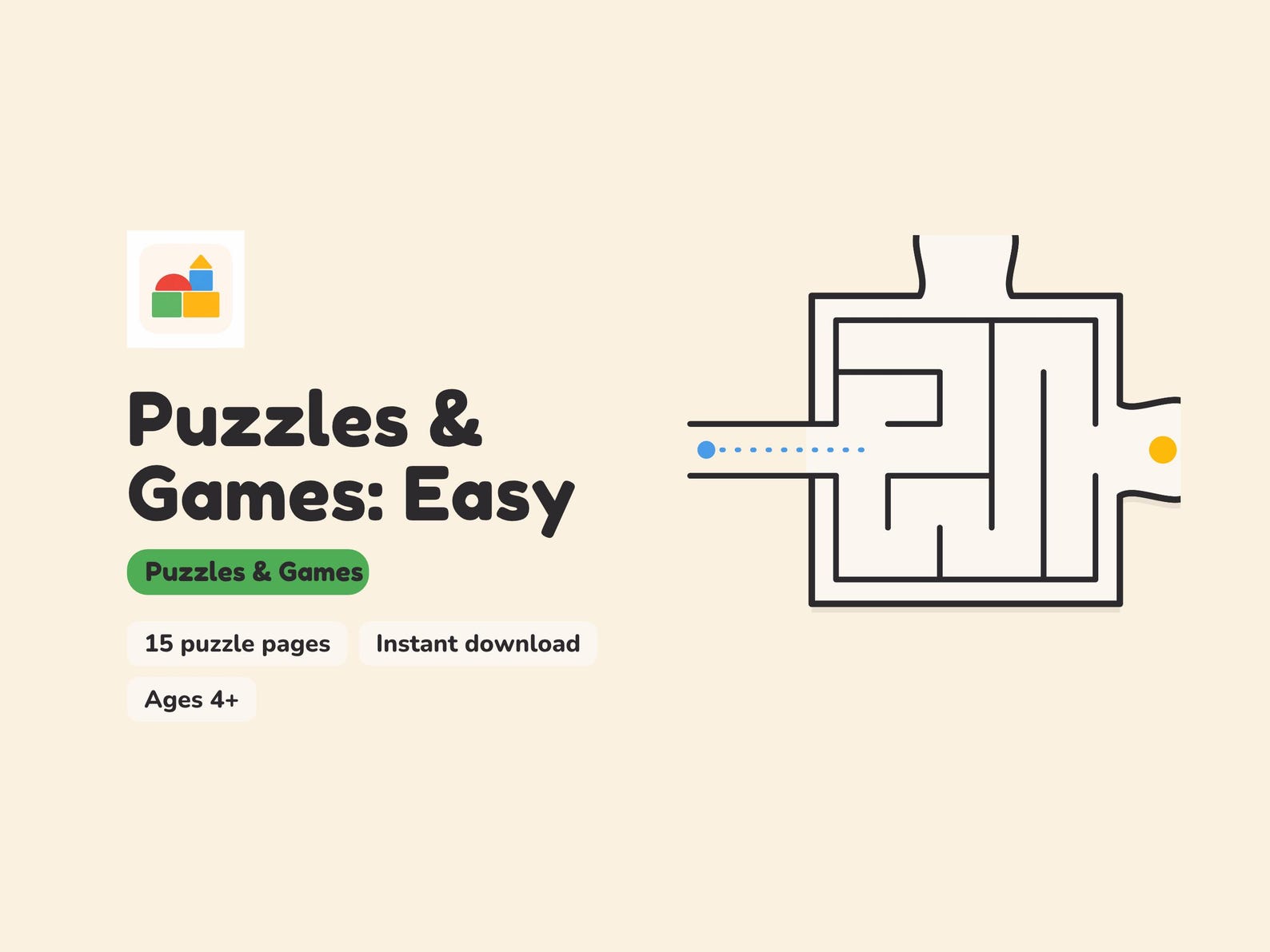
Puzzles & Games: Easy
15 puzzle pages for first solvers, with a lesson plan and answer key.
View printableFrequently asked questions
What makes a printable puzzle book for kids work at home?
One puzzle per page, a clear instruction line, a visible difficulty level, and an answer key at the back that a child can check alone.
Which level should a beginner start with?
Easy. Wide paths and short routes let a child finish independently, which is what builds the habit of starting the next one.
How many puzzle pages should we print at once?
Five to ten. A whole book printed at once becomes a stack, and a stack is easy to ignore.
Some links go to the Etsy shop. Every printable here is one I would use in my own learning routine.