Easy Mazes for Kids: First Steps | YHO Build It For Me
By The YHO Team · October 15, 2026 · 4 min read
Trace the route with a finger, then with a pencil. The two-pass method that makes a first maze feel possible.
Table of contents
Easy mazes for kids are the first rung of puzzle work, and the introduction matters more than the maze itself. A child who is handed a pencil and a page and told to find the way out is being asked to do two things at once: work out a route and control a tool.
Separate them and the first maze becomes possible.
Pass one: the finger
Put the page flat on the table. Ask the child to start at the arrow and trace the route with one finger, slowly. No pencil yet.
The finger pass does two things. It lets the child solve the maze without leaving a permanent mistake, and it shows them that a wrong turn can be reversed. That second lesson is the one that matters most.
If the finger goes down a dead end, say nothing. Wait. Most children back out and try again on their own, and that recovery is the actual skill.
Pass two: the pencil
Now hand over a short pencil. Ask them to follow the route they just found. They will not match it exactly, and that is fine.
Keep the pencil short so the grip has somewhere to sit. Use a clipboard or a book under the page so the point does not dig in.
Set up for a first maze
- One page, not five.
- A wide-path maze with one or two junctions.
- Start and finish marked with a picture, not just a word.
- A flat surface and a short pencil.
- Five minutes, then done.
What easy really means
Easy is not the same as boring. A maze where the route is visible still requires the child to hold a line, turn corners, and stop at the finish. Those are the skills being practiced. The challenge can come later, once the habit exists.
A useful test: can the child finish this maze without asking for help? If yes, it is the right level. If no, go wider and shorter.
Common stumbles
Children often try to draw through walls when they get stuck. Instead of correcting, put a finger on the last good point and ask where they were before that. Walking back is a technique, and it is worth naming.
Another common one: rushing to the finish and missing a turn. Ask them to check the last three squares. Slowing down at the end is a habit that transfers to other paper work.
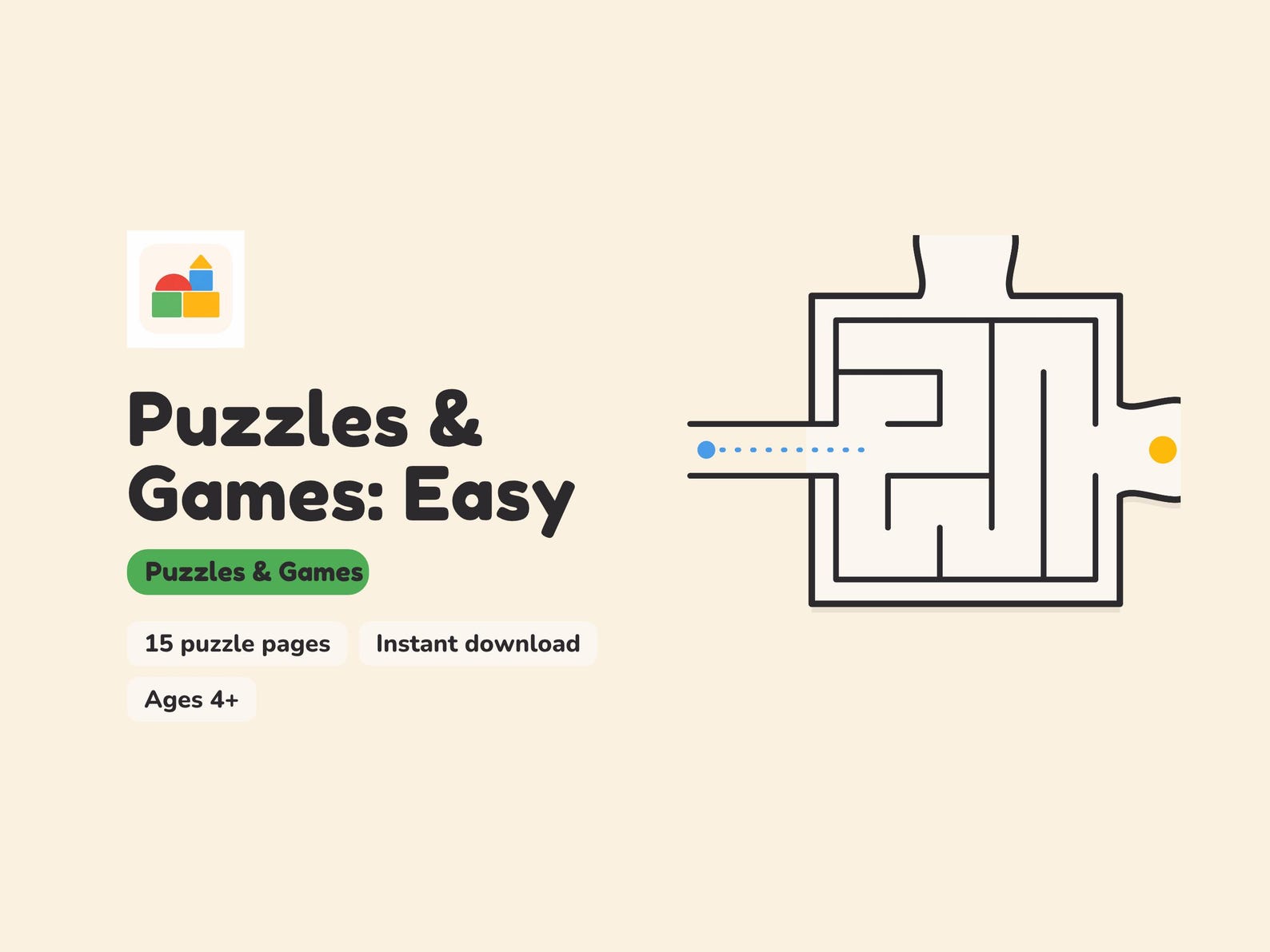
Puzzles & Games: Easy
15 puzzle pages for first solvers, with a lesson plan and answer key.
View printableWhere it goes next
When the finger-then-pencil routine is familiar, read printable mazes for kids for the level descriptions, and the puzzle books guide for how a maze book fits into a shelf.
Making an easy maze in two minutes
Homemade mazes can be pitched exactly at the child, which a printed page cannot.
Draw a large square in pencil. Mark an arrow at one edge and a star at the other. Draw one path between them with two or three gentle turns. Add one dead end. Thicken the walls with a marker, rub out the pencil grid, and it is done.
For a second maze, add a second dead end. For a third, add a junction where both routes look plausible. Three mazes, six minutes, and a set that matches this week's hand.
What to say, and what not to
Say the first step once: start at the arrow and find the star. Then be quiet.
Do not say careful, do not point at the right path, and do not trace it yourself. A finger drawn by an adult solves the puzzle and ends the child's involvement.
If they ask for help, ask a question: which way did you come from? That question works at every level, from a first maze to a hard one.
Repeating a first maze
Do the same easy maze three days in a row. The third attempt is usually clean, quick, and proud, and that feeling is what makes a child willing to try a slightly harder page next week.
The first five minutes
The first five minutes decide whether a maze habit forms. Sit beside the child, say the instruction once, and let the finger do the work before the pencil appears. Do not solve a single corridor. If the child stalls, ask which way they came from rather than which way to go. Easy mazes for kids are not a test of intelligence, they are a test of hand control and patience, and both improve with repetition on the same page rather than with a fresh page each day. Three attempts at one easy maze is a better week than three new mazes.
The finger pass is the step adults skip, and it is the one that makes the first easy mazes for kids feel possible.
Where to start
Print one wide-path maze tonight and ask for a finger pass before the pencil. Easy maze and matching pages are in the YHO Build It For Me shop.
Frequently asked questions
What makes a maze easy enough for a first try?
Wide paths, one or two junctions, and a short route. If a child can see the finish line from the start, it is easy enough.
Should a child use a finger before a pencil on easy mazes for kids?
Yes. A finger pass shows the route without the pressure of leaving a mark, and it makes the pencil pass much calmer.
What if the child draws outside the lines?
Let it stand. Staying inside the corridors comes with control, not with reminders. Offer a wider maze next time.
Some links go to the Etsy shop. Every printable here is one I would use in my own learning routine.